As I mentioned in the first intermission post, there was a lot of turmoil near the end of Season 1 that carried over into the beginning of the second season. In May of 1976, Chevy Chase told Lorne Michaels that he planned to leave the show. Chase returned for the beginning of Season 2 and fulfilled his contractual obligations. His last show as cast member was Episode 6. Bill Murray didn't join until Episode 11, so he wouldn't be seen as Chase's replacement. This meant the cast was shorthanded for several episodes. By the end of the season, Murray found his footing and solidified his place in the cast.
Unlike the transition between its first and second seasons, their would be no major changes in the cast or writer's room.
In between Seasons 2 and 3, the Not Ready For Prime Time Players began to receive more individual recognition. The magazine Crawdaddy, which usually focused on rock and pop music, featured a cover story on John Belushi in its June 1977 issue.
New Times, a bi-weekly news magazine, put Gilda Radner on the cover of their August 19 issue.
The 29th Primetime Emmy Awards ceremony was held on September 11, 1977 about two weeks before the premier of Season 3. Season 1 of Saturday Night received four Emmy nominations and won all four of them. Season 2 got seven total nominations in the following categories:
Outstanding Comedy-Variety or Music Series.
Outstanding Continuing or Single Performance by a Supporting Actress in Variety or Music: Gilda Radner.
Two nominations for Outstanding Supporting Actor in Comedy, Variety/Music Series: John Belushi and Chevy Chase
Outstanding Directing in a Comedy-Variety or Music Series: Dave Wilson, for directing Season 2, Episode 8, hosted by Paul Simon.
Two nominations for Outstanding Writing in a Comedy-Variety or Music Series: For the episode hosted by Sissy Spacek and another episode hosted by Elliott Gould.
The episode hosted by Spacek won the Outstanding Writing Emmy, Saturday Night's only win that night. A far cry from the previous season's sweep, but winning Emmys in its first two seasons proved SNL was no flash in the pan.
SNL's writers celebrate their 2nd Emmy win on September 11, 1977.
Perhaps more importantly, from the perspective of NBC's network executives, SNL's ratings kept improving. During Season 1, it averaged a 6.4 Nielsen rating. For 1976-77, the number rose to 7.9. During Season 3, Saturday Night averaged a 9.8 Nielsen rating.
SNL's ratings increased every season. [1]
It was Season 3 when Saturday Night truly became a nationwide cultural phenomenon. Lots of new characters and recurring sketches debuted that season. Each introduced a new catchphrase:
John Belushi's "Weekend Update commentaries:"But NOOOOO!"
Roseanne Roseannadanna:"It just goes to show you, it's always something."
The Olympia Cafe:" CHEEBURGER, CHEEBURGER CHEEBURGER!"
Lisa Loopner:"That's so funny, I forgot to laugh!"
The Festrunk Brothers:"We are, two wild and crazy guys!"
Dan Aykroyd and John Belushi also made their first TV appearance as the Blues Brothers during Season 3.
Steve Martin hosted three times during the 3rd season, which cemented him as the definitive host of the original cast era. In fact, Martin hosted so often that I still encounter people who think he was part of the cast. Martin's frequent appearances on SNL were mutually beneficial. His album Let's Get Small sold a million copies and reached #10 on Billboard's Hot 100. Episodes he hosted resulted in about a million extra households tuning in to Saturday Night.[2]
Buck Henry continued to host and became the first member of SNL's mythical "Five Timers Club." Saturday NightLive also held its first (and so far, only) Anyone Can Host Contest, which allowed viewers to vote for their choice of a non-celebrity to host the 1977 Christmas episode.
SNL's most frequent host Buck Henry, flanked by Anyone Can Host contestants.
Speaking of hosts, Chevy Chase returned to host during Season 3.
As Saturday Night grew in popularity, the press coverage increased. In December of Season 3, Gilda Radner was the subject of a People magazine cover story.
The following April, Bill Murray was profiled in Rolling Stone, a publication that had been one of SNL's early champions going back to Season 1.
Coverage in rock publications like Crawdaddy and Rolling Stone added a "coolness" factor that other movie and TV actors didn't have at the time. This elevated the Not Ready For Prime Time Players to the comedy equivalent of rock stars.
In March of Season 3, the film American Hot Wax was released. The film's cast included Laraine Newman.
Laraine Newman as "Teenage Louise" in American Hot Wax.
After being a "cult" show on the verge of cancellation in 1976, Saturday Night Live and its cast became part of the mainstream of American popular culture in '78.
In addition to being SNL's most popular season (so far), Season 3 would be the final season that the entire cast saw the show as their primary creative outlet. By Season 4, movies and other side projects would take precedence for some of the cast.
Season 3 is also when I discovered Saturday Night Live. When I began this project, SNL's third season was easily my favorite. I enjoyed Season 2 more than I expected, so we'll see if I still feel the same after this look at the third season.
Check back tomorrow for my annotated review of SNL's 3rd season premier.
Pres. Jimmy Carter (Dan Aykroyd) addresses his fellow Americans and declares that they still need to have fun in spite of the myriad problems that are plaguing the nation. The camera pans out and reveals Carter is sitting on the back of the statue of Andrew Jackson in New Orleans' Jackson Square. The President says that celebrating the Mardi Gras is one way southerners avoid seasonal depression. He's in Nola to enjoy some fun before he returns to Washington to resume his duties.
His wife Roslyn (Laraine Newman) calls to him and says that after two days on the statue, it's time to come down. Carter then draws a sword, waves it in the air, exclaims "yahhhoooo" and then announces "Live, from the Mardi Gras, it's Saturday Night!"
Randy Newman:"Louisiana 1927"
The show then switches to the Mahalia Jackson Center for the Performing Arts, where Randy Newman is stationed and where he will serve as the de facto host of this special. Newman performs his song "Louisiana 1927."
The song originally appeared on Newman's 1974 album Good Ole Boys, which was released on September 10, 1974. "Louisiana 1927" is about the aftermath of the Great Mississippi Flood of 1927, which destroyed 700,000 homes in Louisiana and Mississippi and displaced 200,000 people.
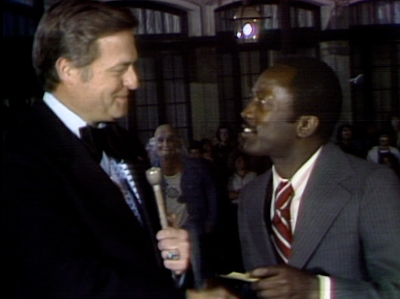
Newman then mentions that the Not Ready For Prime Time Players are strategically placed around the French Quarter and Eric Idle will be covering the crowd's reaction to Mardi Gras. Cindy Williams and Penny Marshall will be reporting from the Krewe of Apollo Ball. Baba Wawa will be interviewing Henry Winlker, who is in Nola to serve as King of the Bacchus Parade.
Newman then throws to Jane Curtin and Buck Henry, who are covering the parade...
Bacchus Parade I
They are sitting atop an elevated reviewing stand and since the Parade is delayed, Curtin throws to the show's next segment:
"Hit Al Hirt In The Face With a Brick Contest" Written by Michael O'Donoghue. Famed trumpeter Al Hirt (John Belushi) attempts to play trumpet...
...while he is pelted with bricks, Wiffle bats, beer cans and other dangerous objects.
Sherri (Newman), Rhonda (Gilda Radner) and their friend (Marshall) have come to the Mardi Gras looking "to meet guys" and are disappointed with the men they've encountered so far.
Their evening livens up the Wild Bees Motorcycle Club (Aykroyd, Belushi, Bill Murray) pulls up on their bikes.
Commcrcial:"Garrett Morris Sings Fat's Domino" Garrett Morris plugs his new album, which features him singing the hits of Nola native Fats Domino.
Randy Newman:"Marie" Back in the performing arts center, Newman sings "Marie," which appeared on his aforementioned album Good Ole Boys.
Film by Gary Weis:"Cemetery"
Saturday Night's filmmaker Gary Weis turns his camera on a New Orleans cemetery worker talks into the camera about how much he loves Nola.
Talk show:"Tomorrow Show with Tom Snyder":
Tom Snyder (Aykroyd) interviews an exotic dancer named Velocity (Williams) and the Honker (Murray), who entices tourists to enter the Pink Lady topless and bottomless bar. Snyder asks Honker why the women who are performing in the bar are wearing pasties and g-strings if it's supposed to be a topless and bottomless establishment.
Bacchus Parade II The Bacchus Parade is still delayed, but Jane and Buck report that King Of The Bacchus Parade Henry Winkler has gone to court to change his name to Helen Hayes. This leads to the next (pre-recorded) segment...
Talk Show:"Baba Wawa At Large" Baba asks her guest Henry Winkler if he has trouble separating himself from the his role as Fonzie on Happy Days. Winkler responds to the question in his regular voice and then in the voice he uses when he plays "The Fonz."
"Bacchus Parade III"
Buck Hen tells viewers that hundreds of traditional events take place during Mardi Gras. One such event is the recreation of Italian Fascist dictator Benito Mussolini's 1940 state visit to New Orleans. Buck then throws to the next segment, which is...
"Ricky Mussolini at the Cabildo"
Written by Tom Davis.
Mussolini's grandson Ricky (Belushi) appears on a balcony in New Orleans' historic Cabildo building, addresses the Mardi Gras revelers below and shouts "Boy you people sure know how to throw a party!"
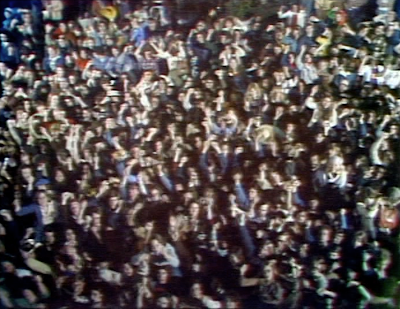
The crowd below responds to Ricky by chanting "DUCE! DUCE! DUCE!
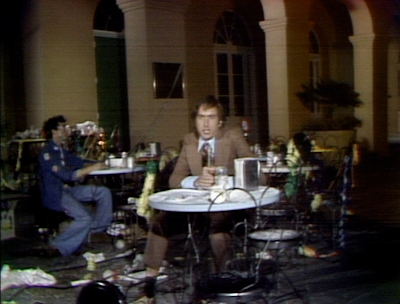
"Mardi Gras Crowd Reaction" Written by Eric Idle. Guest Eric Idle reports on crowd reactions to the Mardi Gras festivities. Unfortunately, by the time he goes on the air, most of the crowd has disappeared!
As Idle signs off, he sings a bit of the song "If I Ruled The World." This song was written by Anthony Newley and Leslie Bricusse for Pickwick, their 1963 musical that was based on Charles Dickens' The Pickwick Papers.
Film by Gary Weis:"Gary Weis Down South" The Civil War ended 112 years before this special aired, but according to this film by Weis, "Dixie" appears to be alive and well...
...all over New Orleans.
The New Leviathan Fox-Trot Orchestra:"Rebecca Came Back From Mecca"
New Orleans' own New Leviathan Fox-Trot Orchestra performs "Rebecca Came Back From Mecca."
"Bacchus Parade IV" The parade is still delayed, so Buck and Jane throw to Penny Marshall...
"Krewe Of Apolllo Ball" Penny is anchoring SNL's coverage of the inaugural Krewe Of Apollo Ball. In this event, a series of queens and debutantes parade around the ball. All the "debutantes" and "queens" in the ball are men. Penny is joined by New Orleans writer and historian Roberts Batson, who provides more information about the ball.
"Stella" In a scene taken from A Streetcar Named Desire, Stanley Kowalski (Belushi, channeling Marlon Brando) wanders through the streets of New Orleans looking for his wife Stella and screaming her name.
He stops at a house where he suspects Stella is hiding. When a man (Morris) steps out on to his balcony, Stanley realizes he may be looking in the wrong place.
Paul Shaffer and Michael O'Donoghue:"The Antler Dance" Written by Michael O'Donoghue, Marilyn Suzanne Miller and Paul Shaffer. The show shifts back to the performing arts center, where Saturday Night piano player Paul Shaffer sings "The Antler Dance." This song and its accompanying dance were introduced and performed by Lily Tomlin during the season premier of SNL's second season.
During the song, SNL's cameras cut to the French Quarter where Michael O'Donoghue performs the dance on a balcony. He puts his hands together and puts them on his head to form "antlers."
Some of the people in the crowd below join in and do the dance, while Shaffer is superimposed onscreen.
"Weekend Update" Jane and Buck report on the top news stories of the day, which include: New Orleans mayor Moon Landrieu gives Nola native Garrett Morris the "Combination To The City."
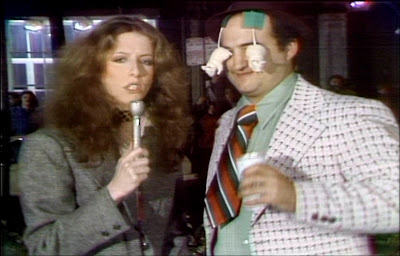
Correspondent Laraine Newman interviews a tourist (Belushi) who is celebrating "Mouse Sunday" by taping live mice over his eyes.
Update's roving reporter Emily Litella is excited to be at the Mardi Gras for the first time. She interviews a "liverboat" captain (Murray) and asks what it's like to transport "loads of liver." As usual, Litella appears to be a bit confused.
Randy Newman:"Kingfish" Newman performs another song from Good Ole Boys. "Kingfish" tells the story Huey P. "Kingfish" Long, who served as Louisiana's governor and later U.S. Senator during the Great Depression.
"New Orleans 1813:A Visit With Jean Lafitte"
Notorious privateer and "independent marine contractor" Jean Lafitte (Murray) goes out of his way to tell people he NEVER wants to be called a pirate.
Lafitte kills several people who make the mistake of calling him a pirate.
"Apollo Ball II" Back at the Apollo Ball, Penny has now been joined by her Laverne & Shirley co-star Cindy Williams, who helps Penny cover the ball.
Williams arrives just in time for the crowning of the queen of the ball.
Randy Newman:"Sail Away" Newman sings the title track from his 1972 album.
Randy Newman throws to the Bacchus Parade one more time and they explain why the parade still hasn't started. Curtin throws back to the theater, where Newman then says goodnight and ends the special.
Notes about this episode:
I respect Lorne Michaels for attempting to take Saturday Night out of it's home studio and staging the show in an unusual setting. Mardi Gras in New Orleans is a very difficult time and place to put on a live TV show and lots of things went wrong. With this in mind, I'm sort of grading this special on a curve, since there was so much chaos swirling around the cast and crew.
There were lots of behind the scenes issue that plagued this special episode that have been documented in books and articles. Rather than give a blow-by-blow summary of those sources, I'm going to link to articles that are available online at the bottom of this review. The book Saturday Night, written by Doug Hill and Jeff Weingrad,has an entire chapter dedicated to the Mardi Gras special, I recommend that chapter for more details. Live From New York, by Tom Shales and James Andrew Miller also contains a few quotes from the cast and guests about what happened during the production of this special.
TV Guide ad for Saturday Night Mardi Gras Special.
The Bacchus Parade was delayed until after the special was over. It was postponed due to a car accident on the parade route, some accounts of the accident say it was a fatal collision. Jane Curtin was interviewed on Late Night With Seth Meyers last year and talked about what she experienced during the Mardi Gras show. Here's video of Curtin's Late Night appearance:
Penny Marshall seems a bit out of it during the Krewe ball, but it's not her fault. Marshall was very sleep deprived and jetlagged and was overwhelmed by the Mardi Gras atmosphere. As soon as the Bees sketch ended, Marshall endured a dangerous ride on the back of a motorcycle to the ball, which rattled her even more. Marshall was described as "catatonic" by the time she arrived at the drag ball.
During the "Combination to the city sketch," a man in a mask can be seen approaching Garrett Morris and Moon Landrieu, as seen in this screen capture:
The masked-man was not affiliated with the show, he was just a random Mardi Gras attendee who saw a camera and got within a few feet of Moon Landrieu and Garrett Morris before he was pulled away by the crew.
The "Al Hirt" sketch was based on a 1970 Mardi Gras incident when Hirt was hit with a brick. This account of the assault on Hirt appeared in the February 11, 1970 edition of the New York Times:
"Al Hirt, the city's famous trumpet player, was hit in the mouth with a brick thrown from a crowd night before last. The unknown brick‐thrower could not have known his victim. Mr. Hirt was masked, riding a float in a carnival parade. The brick cut his lip so severely that 12 stitches were required. He does not know whether he will be able to play the trumpet again."
The Meters are billed as appearing on the show during the opening credits, but they don't perform. They were scheduled to close out the special with two songs, but they were cut when the show ran long.
It's also worth noting that the Saturday Night Mardi Gras Special was only rerun once (during SNL's regular Saturday timeslot) and then disappeared from circulation for nearly 30 years, until it was released on the Season Two DVD set.
Classic moment:
Debut of the Honker-This special features the first appearance of a recurring character. Bill Murray would play the Honker five more times during his tenure as a Not Ready For Prime Time Player. He also portrayed Honker three more times when he returned to host SNL.
What stands out:
Jane Curtin and Buck Henry at the Bacchus Parade-These two display poise and bravery while an increasingly hostile and drunken crowd is hurling projectiles and attempting to climb up the reviewing stand. Henry and Curtin show that they were true showbiz professionals in the midst of a very difficult scenario.
The punchline Curtin delivers at the end of the special is one of the best jokes I've ever heard, so good that I won't spoil it for you in this review. Writers Alan Zweibel and Herb Sargent also deserve kudos, since they had to write jokes on the spot and hand them up to Henry and Curtin.
"Stella!"-John Belushi had already impersonated Marlon Brando on SNL, so this sketch was a no-brainer, since A Streetcar Named Desire takes place in New Orleans.
John Belushi, playing Stanley Kowalski, steps off the Desire Stretcar.
Eric Idle-His appearance is brief, but Idle's "report" about the Mardi Gras crowds is hilarious.
Baba Wawa's interview with Henry Winkler-When I was a kid I was a big fan of Happy Days and Fonzie was my favorite character on that show. It's fun to watch Winkler go back and forth between his own "regular" voice and the voice he used when he played Fonzie. It's also fun to watch Winkler interact with Gilda Radner, since both were 1970s TV icons.
What doesn't work: Not enough Garrett Morris-New Orleans native Garrett Morris was excited about returning to his hometown. He even wrote a new song called "Walking Down Bourbon Street." Morris wanted Gary Weis to film him singing the song on Bourbon St. for the special, but that film was never produced. Sadly, he doesn't get to do much here. It's a shame that someone of Morris' talents was treated so shabbily during his homecoming. It's all the more insulting that the show could find time for four Randy Newman songs and a performance by the New Leviathan Orchestra, but no room to showcase Morris. Many years later, Morris recorded "Walking Down Bourbon Street" for his 2014 album Black Creole Chronicles, you can hear the song in the video below:
Too much Randy Newman-In Hill and Weingrad's aforementioned Saturday Night book, we're told Newman performed four times because he was stationed in a theater, which made it easier to cut to him than to other performers who were in the streets of Nola. I generally like Newman's work and I respect his place in the history of American music, but four Newman songs in one special is at least one song too many.
Ricky Mussolini-This sketch consists of lots of buildup with little payoff. Buck Henry does a long intro for the Mussolini reenactment. John Belushi, playing Ricky says "Boy you people sure know how to throw a party!" Then it's over. I will admit that it's legit disturbing (and darkly humorous) to hear the Mardi Gras crowd chanting "Duce!," but this sketch didn't add much to the special. Maybe technical issues forced them to cut away early from the Cabildo?
J.A. Morris' rating: For the first time (and probably the last, since this is a unique episode/special), I'm going giving two different ratings.
For the special's content: I wish I could tell you the Saturday Night Mardi Gras Special is a "lost classic" episode of SNL, but it's a mess, in spite of the admirable effort of the cast and crew. However, it's a historically significant moment in the series' history and it has enough stand-out moments that make it worth watching at least once, especially if you're a hardcore fan of Saturday Night Live.
2 and a half stars.
For the effort of the cast, crew and guests:
Everyone gave it there all and did the best they could under extremely difficult, and in some cases life-threatening circumstances. Their efforts receive my highest rating.
4 stars!
Sources:
Saturday Night, Chapter 8:"Nola," by Doug Hill and Jeff Weingrad.