Thursday, June 4, 2020

Season 1, Episode 22, Host:Elliott Gould, with Leon Redbone, Harlan Collins & Joyce Everson


Aired May 29, 1976.

Cold opening:"Wax Museum"
In a wax museum, a flasher (Chevy Chase) approaches several wax statues and exposes himself to them.


He then approaches a wax statue of a woman (Gilda Radner) and kisses her neck.  Suddenly, the statues comes to life and slaps the flasher!  He slaps her back, she returns fire with a slap that sends the flasher tumbling offstage.


The flasher then looks into the camera and announces "Live, from New York, it's Saturday Night!"


Monologue:"Anything Goes"
Host Elliott Gould performs the song "Anything Goes," the title song of Cole Porter's 1934 musical of the same name.


Commercial:"Academy Of Better Careers"
Repeat from Episode 1.

"European Poker:
In 19th century New Orleans, a man named Mr. Rousseau (Dan Aykroyd) plays poker with a European man named Ramone Diarga (Chase) and his translator Moe Greenstein (Gould).  They use "European Rules" to cheat Rousseau out of his money.


Commercial:"National Uvula Association"
Written by Rosie Shuster.
A PSA that encourages viewers to have their uvula regularly treated.


Leon Redbone:"Shine On Harvest Moon"
This song was written by Nora Bayes and Jack Norworth and first performed as part of  Ziegfeld Follies in 1908.  Leon Redbone recorded it for his 1976 album Double Time.


Star Trek:"Last Voyage Of The Starship Enterprise"
Written by Michael O'Donoghue.
Captain Kirk (John Belushi), Mr. Spock (Chase), Dr. McCoy (Dan Aykroyd) encounter a menace that even they can't defeat:Cancellation!


"Muppets Postcard":
Gilda Radner reads a postcard from the Muppets, who are in England.


"Weekend Update":
Anchor Chevy Chase reports on the days headlines, which include:
"Cuban premier Fidel Castro announced that he is pulling out of Angola. A frustrated Angola could not be reached for comment."

Presidential candidate Jimmy Carter and his wife Roslyn have their cheeks epoxied together.  


Audrey Peart Dickman (Jane Curtin) junior chairperson of the Bicentennial Business Affairs Committee defends ad campaigns that exploit America's Bicentennial celebration...while Chevy makes faces behind her back.


Plus, a new feature:News For Emily Litella Fans!  Chevy repeats the night's top story with the aid of editorial commentator Miss Emily Litella.


Commercial:"Rovco Vibramatic"
A couple (Gould and Newman) promotes a vegetable slicer that's also a "personal massager!"


"Shirley Temple in Ghana":

U.S. Ambassador to Ghana Shirley Temple Black (Newman) gets leaders (Gould and Garrett Morris) of warring factions in Ghana to settle their differences by singing and tap-dancing instead of killing each other.


Film by Gary Weis:"Uncle Charlie's School"
Weis and Gould visit Charlie Lowe's School Of Theatrical Arts, where Gould took dancing and diction lessons as a child.


"Bee Honeymooners":
Ralph Kramden (Belushi) accidentally sits on his wife Alice's (Radner) knitting needles.  Since Alice is always knitting, Ralph's neighbor Ed (Aykroyd) theorizes that she's pregnant.  


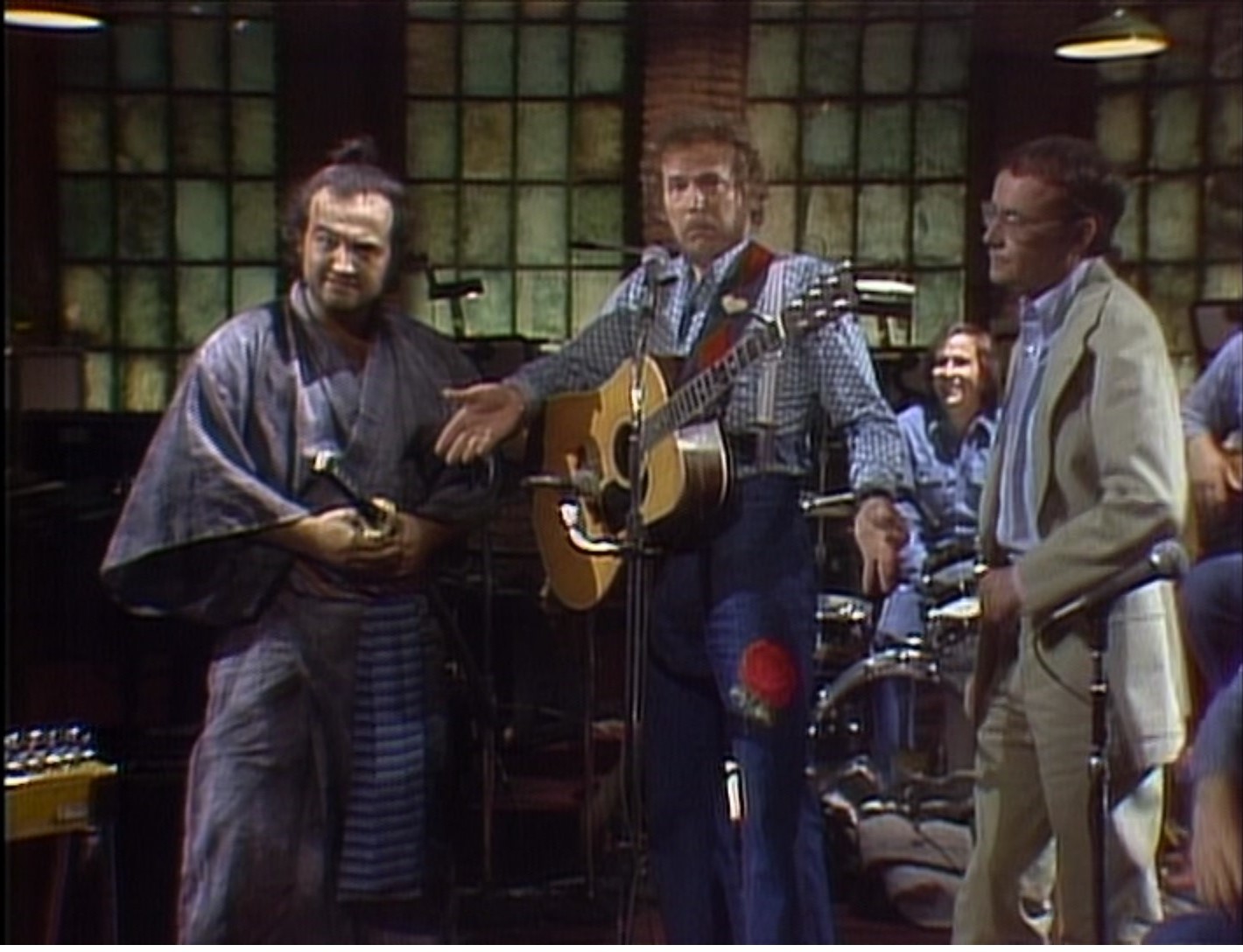
Leon Redbone:"My Walking Stick"
"My Walking Stick was written by Irving Berlin and was first recorded by Ray Noble and his Orchestra in 1938.  Redbone's recording of the song appeared on his 1975 album On The Track.  Tubist Jonathan Dorn provides accompaniment to Redbone.  


"Show Us Your Guns"
Repeat from Episode 1.

Harlan Collins & Joyce Everson:"Heaven Only Knows"


The duo performs "Heaven Only Knows."
(see notes below)

"Goodnights":
Gould and the cast appear on home base dressed as cowgirls.  The host says they're taking a vacation and they all sing "Happy Trails," which was written by Dale Evans and made famous by Evans and her husband Roy Rogers.  Evans and Rogers first recorded "Happy Trails" in 1952.  


Notes about this episode:
John Belushi says "Promise" at the end of the 'Star Trek' sketch.  This is a reference to William Shatner's appearances in commercials for Promise brand margarine, which ended with Shatner saying "Promise."  Here's a video of one of those commercials:


Speaking of the Star Trek sketch, Mr. Sulu is played by SNL production designer Akira Yoshimura.  He's worked on the show from the beginning to the present.  Yoshimura also played Sulu in two other Star Trek sketches during seasons 12 and 19.

Akira Yoshimura as Mr. Sulu.

The "Shirley Temple In Ghana" sketch is based on Shirley Temple's second career.  In case anyone doesn't know, 1930s child star Shirley Temple did indeed serve as U.S. Ambassador to Ghana.  She was known as Shirley Temple Black during her diplomatic career, which began when Pres. Richard Nixon appointed Black to be a delegate to the United Nations General Assembly in 1969.  She was appointed Ambassador to Ghana by Pres. Gerald Ford in 1974 and later appointed by Pres. George W. Bush to serve as Ambassador to Czechoslovakia.

Shirley Temple Black, seen here while she served as U.S. Ambassador to Ghana.
"Heaven Only Knows,"  the song performed by Harlan Collins & Joyce Everson on this episode, was never released on any album.  Harlan Collins was kind enough to answer my question about the song on his Facebook page.  While searching for info about the song, I also discovered that Collins writes a one-sentence humor piece for Tribune Newspapers called Today's Chuckle.


Jane Curtin plays an editorial commentator named Audrey Peart Dickman.  This name is a reference to the the real Audrey Peart Dickman, who served as SNL's Associate Producer for many years.

Associate Producer Audrey Peart Dickman during the early years of SNL.
Classic moment:
The Star Trek sketch has appeared in lots of SNL clip shows and has been called the greatest Saturday Night sketch of all time.  I wouldn't go that far, but it's one of the strongest sketches of season one and it's still hilarious 44 years after it aired.  Everyone does an impression of William Shatner today, but Belushi was the first and his performance is still amazing to behold, one of Belushi's best moments on the show.


What stands out:
"Shirley Temple in Ghana"-This great sketch is a nice showcase for the singing and dancing talents of Laraine Newman, Garrett Morris and Elliott Gould.


"Uncle Charlie's School"-This is one of Weis' better films this season and it was nice to learn more about Gould's background.  

"Bee Honeymooners"-An excellent parody of the classic comedy show and a new, clever way to use the Bees.  Aykroyd, Belushi, Curtin and Radner are all great in this sketch.  


J.A. Morris' Rating:
This is another great episode, Star Trek earns the episode a 4-star rating all by itself, but it's a strong episode from start to finish.  


4 stars!

Saturday, May 2, 2020

Season 1, Episode 21, Host:Buck Henry, with Gordon Lightfoot


Aired May 22, 1976.

Cold opening:"Chevy is injured."
Chevy Chase limps out on crutches and says he injured his leg while accepting an Emmy award a few days earlier, which means he can't perform his usual opening fall.


Laraine Newman has agreed to do the fall, even though (in Chevy's opinion) she hasn't been trained to perform pratfalls.  Chase also mentions that women in general aren't very good at physical comedy.

Newman arrives on stage, thanks Chevy for the opportunity, takes one of his crutches and pushes him off the stage.  Chase then announces "Live, from New York, it's Saturday Night!"


Monologue:"Where's Buck"
When it's time for host Buck Henry to perform his opening monologue, Henry is nowhere to be seen.  Producer Lorne Michaels learns he's stuck at the front desk, because he doesn't have a pass and the NBC security guard (George Coe) doesn't recognize him.


By the time Lorne gets him upstairs and onstage, director Dave Wilson tells Henry that the show's running behind schedule and Buck only has time to say "we'll be right back!"


Commercial:"Peter Lemon Moodring"
Singer Peter Lemon Moodring changes to different colors that reflect the mood of the songs he performs.


Samurai Tailor:
On the day before his wedding, a customer (Buck Henry) asks a Samurai tailor (John Belushi) to make him a tuxedo. Everything is going smoothly until the tailor makes sleeves that have six buttons instead of one.


"Talk Back, with Frank Nolan"
Frank Nolan (Henry) hosts a call-in show, the topic for the evening is federally supported municipal bonds.  When no one calls in, Nolan changes the topic to more controversial topics (like teaching school children that Soviet communism is good for them), hoping to goad angry viewers into calling the show.


Commercial:"Del Stator's $.99 Toad Ranch"
Del Stator (Dan Aykroyd) promotes his restaurant, which promises the best $.99 toad steak they can buy.


Gordon Lightfoot:"Summertime Dream"
Musical guest Gordon Lightfoot performs the title track from his forthcoming album, which was released in June of 1976.


Commercial:"Polaroid Cameras"
In a real (live) commercial, Garrett Morris and Gilda Radner promote Polaroid cameras.


"Weekend Update":
Anchor Chevy Chase reports on the news of the day, which includes:

Pres. Gerald Ford tries four times (unsuccessfully) to shake hands with George Romney.


And the Surgeon General declares Jimmy Carter's teeth dangerous and lethal weapons.


Commercial:"Germasol"
Repeat from Episode 10.

Casting Extras:
A director (Henry) casts extras to play a crowd in a feature film.


Beatles Offer #2:
Saturday Night producer Lorne Michaels reminds viewers of his offer to pay the Beatles $3000 to perform three songs.  The recent acclaim and awards SNL has received has given him the ability to increase the offer to the much more generous sum of...$3,200!


Talk Show:"Not For Ladies Only"
Baba Wawa interviews Italian film director Lina Wertmuller.


Film by Gary Weis:"Toilet Seats"
Buck Henry visits a store that sells toilet seats and interviews its staff and customers.


Talk show:"Looks At Books"
Jane Curtin interviews sexologist Henry T. Rudin about his new book titled The Ultimate Expression. Rudin says the book will explain how couples can achieve...the ultimate expression.


Gordon Lightfoot:"Spanish Moss"
Lightfoot sings another song from his Summertime Dream album.


"Only Two Songs!"
When the musical guest begins performing another song, Henry interrupts and tells Lightfoot he only gets to perform two songs.  Samurai Futaba (Belushi) cuts the strings on Lightfoot's guitar to make sure he doesn't play another song.


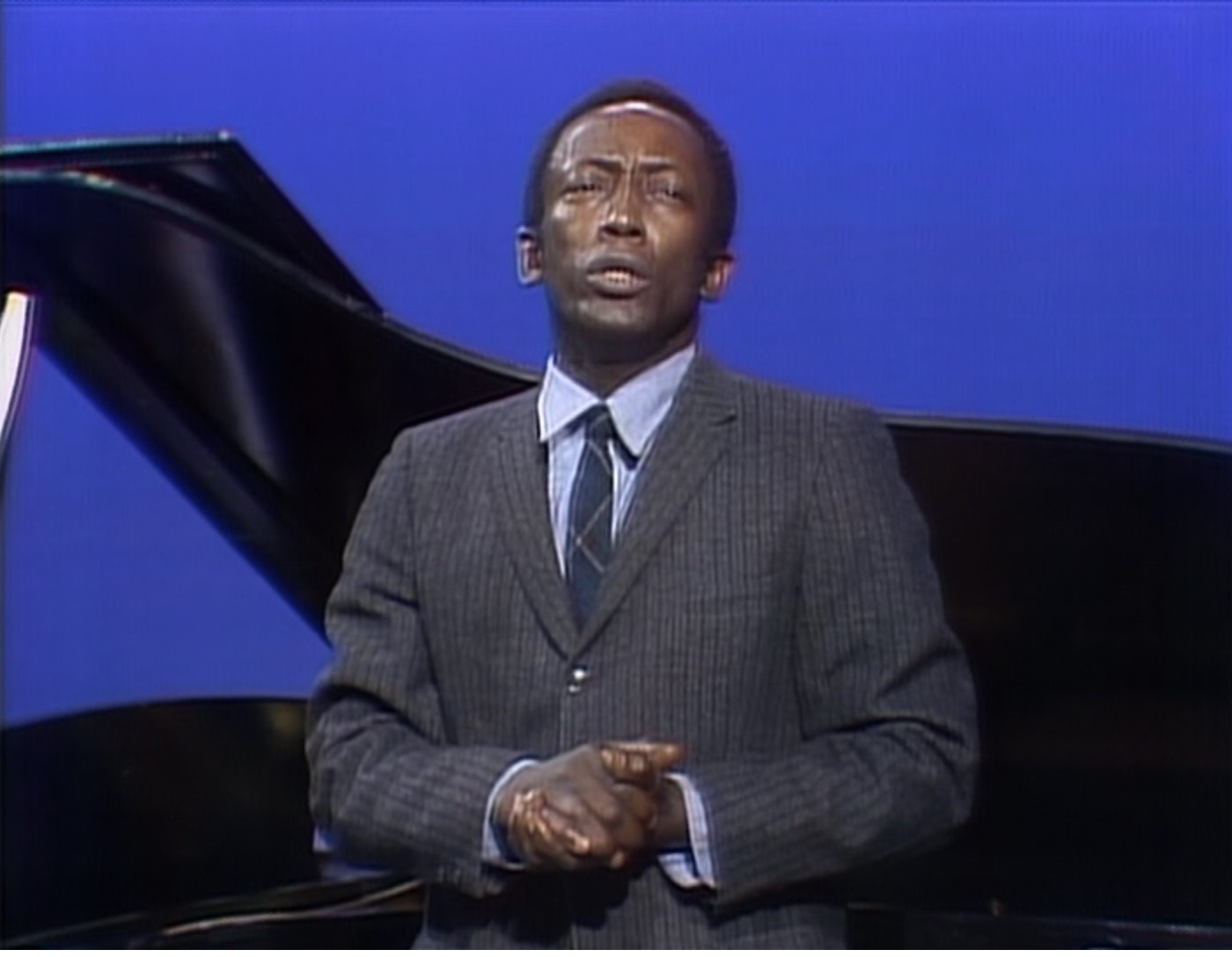
Garrett Morris:"An Die Musik"
Garrett Morris sings "An Die Musik," which was composed by Franz Schubert in 1817, with lyrics taken from a poem written by Franz Von Schober.


During the performance, text scrolls onscreen that explains why Garrett is singing a serious, operatic song in the middle of the show.


Impressionist Michael O'Donoghue:
Impressionist (and SNL writer) Michael O'Donoghue wonders what would happen if someone plunged large steel needles into the eyes of the pop music trio Tony Orlando and Dawn.


He and two women ("impersonating" Dawn) show the audience how Tony Orlando and Dawn would react to such torture.


Goodnights:
O'Donoghue and "Dawn" are still writhing on the stage in agony while Buck and the cast arrive onstage to say goodnight.


Notes about this episode:
This is Buck Henry's last appearance during SNL's first season.  It's the only season where Henry didn't host the season finale.

What stands out:
"Samurai Tailor"-Another great samurai sketch.  Samurai sketches that featured Henry as the "straight" character were always a little better than Samurai sketches that paired John Belushi with other hosts.


"Talk Back, with Frank Nolan"-Henry is great in this solo sketch.  Frank Nolan gets increasingly desperate for people to call in and Henry makes his desperation feel palpable.


"Del Stator's $.99 Toad Ranch"-Dan Aykroyd performs another fast-talking pitchman in this great commercial parody.

Garrett Morris' performance of "An Die Musik"-This is a reminder that Morris had an amazing voice.  He should've been given more chances to show off his voice during his time on SNL.


J.A. Morris' rating:
Buck Henry's first appearance on the show featured several classic moments ("Samurai Delicatesen," "An Oval Office," "Citizen Kane II") and was one of the best shows of the season.  This episode is good, but it's not quite as strong as Henry's earlier show.


3 stars.

Friday, May 1, 2020

Intermission #1:The 1976 Emmy Awards...and a cast member leaves SNL.

Milton Berle, AKA "Mr. Television" presents an Emmy to Lorne Michaels.
(photo borrowed from Saturday Night, A Backstage History of Saturday Night Live)

I'm taking a break from reviewing episodes to put the latter third of Season 1 into context. [1]  I plan to write more of these "Intermission" posts in the future, such as the beginnings and ending of seasons, cast changes, etc.

Forty years of documentaries and clip shows might give those who weren't around in 1975-76 the impression that SNL was a hit show from day one.  It was not a ratings success during its first season and episodes were often over-budget.  Some NBC executives favored killing the show, since it cost much more to produce than the Tonight Show reruns that previously ran in its timeslot.   In the Spring of 1976, NBC's Saturday Night was in serious danger of being cancelled.

In fact, NBC in general was in serious trouble at this time.  The 1975-76 season was disastrous for the network.  Eight series that made their debut that season were not around for a 2nd season. Many of these series didn't even make it to the end of the season before getting the axe.

Unlike those cancelled series, Saturday Night received lots of critical acclaim in publications like the The New York Times, The Washington Post and The New Yorker.   This meant the show was one of the few positive things NBC executives could talk about at the time.

In the middle of the critical praise and talk of cancellation, two events took place between May 10 and 17.

During the first season, Chevy Chase became the series' first breakout star.  In addition to Chase being very funny and talented, his stardom rose because he often used his real name onscreen and had two personal showcases every week:"Weekend Update" and the opening fall.  He was getting lots of offers from all over the entertainment industry and was appearing on the cover of magazines.

Chevy Chase appeared on the cover of the December 22, 1975 issue of New York magazine.

Chase was seen as a potential movie star or a successor to Johnny Carson as host of The Tonight Show.  NBC was desperate to keep a hot commodity like Chase on their network.  At a May 10 meeting, Chase's representatives secured a lucrative deal that committed him to appearing in several NBC TV specials...and leaving Saturday Night.  Chase took more money for a much lighter work schedule.  A clause in his new contract with NBC stated that he would leave in October of the second season.  His last show as an "official" member of SNL's ensemble was broadcast on October 30 of Season 2, followed by a few cameo and pre-taped appearances which fulfilled his contractual obligations.

Now it's commonplace for SNL's cast members for to depart to the show for Hollywood.  But I imagine fans of the show at the time were shocked and saddened when they heard Chevy Chase was leaving.

A week after that, on Tuesday, May 17 (three days after the episode hosted by Dyan Cannon), the 28th Primetime Emmy Awards ceremony was held in Los Angeles.  Saturday Night was nominated in the following categories:

Outstanding Comedy-Variety or Music Series
Outstanding Directing in a Comedy-Variety or Music Series:Dave Wilson, for directing Episode 2, hosted by Paul Simon.
Outstanding Writing in a Comedy-Variety or Music Series:For Episode 10, hosted by Elliott Gould.
Outstanding Supporting Actor in Comedy, Variety/Music Series:Chevy Chase
Outstanding Achievement in Graphic Design and Title Sequences:Edie Baskin and Bob Pook, for episode 11, hosted by Buck Henry.

Its competition in the Comedy-Variety, writing, directing and acting categories was The Carol Burnett Show and The Sonny And Cher Show, two shows that represented "the establishment" of the TV world.

Saturday Night won four Emmy Awards that night, losing only in the Graphic Design category.

SNL's writers celebrate at the 28th Prime Time Emmy Awards.
(photo source: Disney ABC Television Group)

Here's footage of Saturday Night producer Lorne Michaels accepting the award for Outstanding Comedy-Variety or Music Series:


Chevy Chase won two Emmys, one for his writing and another for Outstanding Supporting Actor, beating out Tim Conway and Harvey Korman of Carol Burnett.  Here's a clip of Chase winning his acting Emmy:


The Emmys changed everything.  After winning the awards, Saturday Night gained a million viewers.  Ten days after the Emmy ceremony, NBC placed an ad in The New York Times that saluted all of the network's Emmy winners.  A photo of SNL's writers and director Dave Wilson was placed at the top of the ad.


In order to cash in on the Emmy victories, NBC requested the production two additional episodes of Saturday Night that would be aired in July.

After the Emmys and Chevy Chase's departure, the show would never be the same.

I hope you enjoyed this bit of SNL history, please stop by tomorrow when I examine Buck Henry's second appearance as host of Saturday Night.

See you then,
J.A.

Footnotes:
[1]Saturday Night, by Doug Hill and Jeff Weingard, p.145-156